MUSIC AT 26
On 18 September 2000, Madonna released Music, a record arriving in the long afterglow of Ray of Light but refusing to live inside it. Where another artist might have repeated the formula, Madonna changed direction again.
William Orbit’s spacious electronics gave way to Mirwais Ahmadzaï’s clipped guitars, fractured beats and digitally manipulated vocals. The spiritual searching of the previous record had not disappeared, but it had been pushed into a stranger, more playful and occasionally colder landscape.

Twenty-six years later, Music occupies a fascinating position in Madonna’s catalogue. It connects the transformation of Ray of Light with the questioning and disillusionment that would surface more explicitly on American Life. It is also a record I hear differently now than I did in 2000. What once seemed immediate, colourful and futuristic increasingly reveals itself as one of Madonna’s great transitional works.
AFTER THE LIGHT
Ray of Light had given Madonna something artists spend careers pursuing: enormous commercial success accompanied by a profound critical reassessment. She could easily have stayed there.
Instead, she moved.

Music does not attempt to reproduce the atmosphere of its predecessor. Its surfaces are harder, its rhythms more fragmented and its humour more visible. Madonna was still working with William Orbit, but the decisive new presence was Mirwais Ahmadzaï, whose production introduced a more fractured electronic language.
There is something quintessentially Madonna in that decision. Having reached one artistic summit, she showed remarkably little interest in building a house there.
ENTER MIRWAIS
Mirwais changed the temperature.
His production often feels deliberately unsettled. Guitars appear in clipped fragments. Vocals distort, stretch and fracture. Beats seem capable of breaking apart before suddenly snapping back into place.

The title track, Music makes the new direction immediately accessible, but elsewhere the experiment becomes stranger. Impressive Instant, Runaway Lover, Nobody’s Perfect and Paradise (Not for Me) reveal a record fascinated by the collision between the human voice and the machine.
Rather than using technology simply to polish Madonna’s performance, Music frequently allows the machinery to interfere with it.
That interference became part of the record’s character.
COWBOYS IN THE MACHINE
Then there was the image.
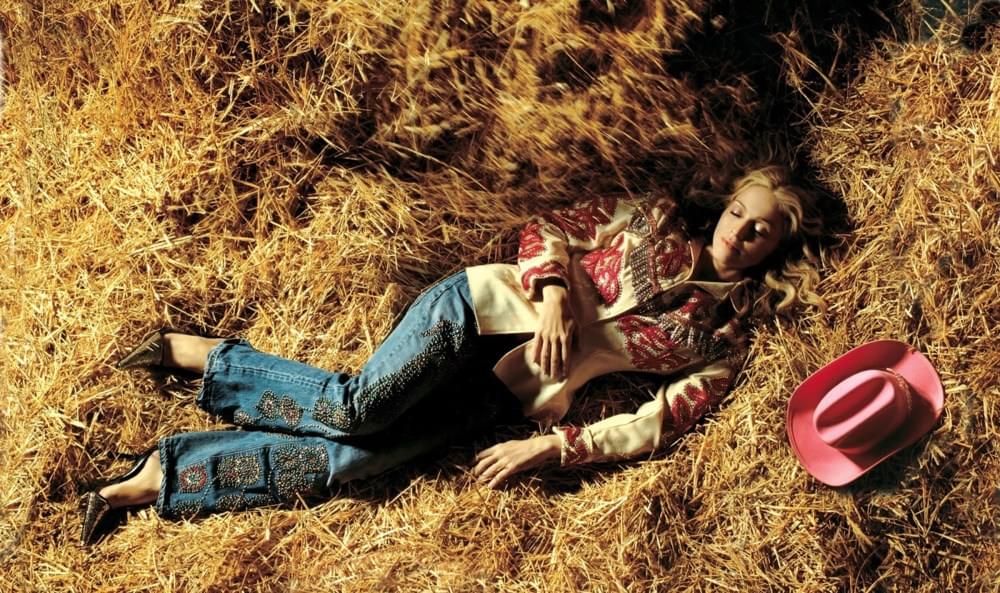
Madonna entered the millennium wearing rhinestones, denim, cowboy hats and Western iconography while making some of the most aggressively digital music of her career.
It should not work.
That may be precisely why it does.

The visual language of Music looks backwards towards an imagined America while the record itself pushes forward into European electronic experimentation. Horses meet synthesisers. Americana meets French club culture. Nostalgia becomes packaging for futurism.
Madonna has always understood contradiction as a creative tool. With Music, contradiction became almost the organising principle.
BENEATH THE PARTY
The enormous success of Music can make the record appear lighter than it actually is.
Its title track is joyous and communal. The follow up track Don’t Tell Me is playful and defiant. Yet beneath those singles sits a much more introspective record.
Nobody’s Perfect carries insecurity beneath its digital surface. I Deserve It is unusually direct. Paradise (Not for Me) feels detached, melancholy and almost spectral.

Listen from the perspective of American Life and another version of Music begins to appear.
The questions about identity, fulfilment, celebrity and emotional connection that would become explicit three years later are already forming here.
Music therefore becomes more than the record after Ray of Light. It is also the road towards what came next.
TWENTY-SIX YEARS LATER
I do not hear Music now exactly as I heard it in 2000.
At the time, much of its impact came from its immediacy: the sound, the imagery, the released tracks and the sensation that Madonna had once again arrived somewhere before everyone else.

Twenty-six years later, I am more interested in the record underneath that spectacle. I hear its transitions more clearly. I hear Madonna moving away from one celebrated creative identity before another has fully formed. I hear the beginnings of American Life inside songs I once understood quite differently.
That may ultimately be what makes Music endure.
It captures Madonna between destinations.

She had already transformed herself through Ray of Light. She had not yet arrived at the confrontation of American Life. For a brief moment she occupied the space between them, surrounded by cowboy hats, broken electronics and one of the biggest pop songs of her career.
And rather than sounding uncertain, she made transition itself sound like freedom.


Leave a Reply